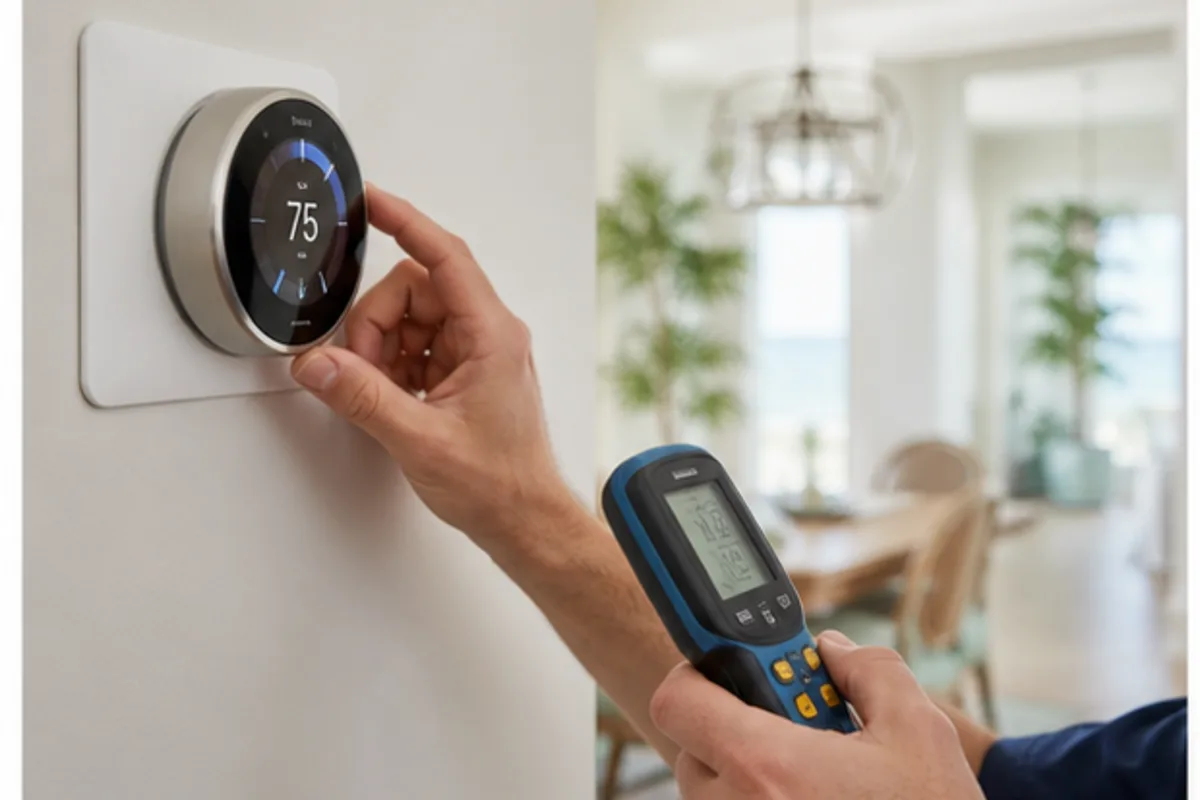
thermostat repair and installation decision context for Jacksonville properties
A new thermostat can improve control only when it is compatible with the equipment and the apparent thermostat problem is not a safety or power interruption elsewhere. The commercial decision begins with the property impact and the installed condition, not a generic part recommendation. Two Jacksonville customers can use the same words while their systems differ in controls, equipment pairing, airflow, drainage, exposure, maintenance history, and access. The appointment should preserve those differences until testing supports a specific repair, maintenance, or replacement scope.
Record when the condition appears, which rooms or business zones are affected, whether the thermostat satisfies, how the system sounds, and which change preceded the complaint. Relevant context can include weather, occupancy, a filter change, renovation, utility interruption, prior service, schedule override, or a newly used room. That timeline selects useful checks but never becomes a remote diagnosis.
- display and power
- equipment type and stages
- sensor location
- schedule and user priorities
Jacksonville HVAC safety steps before thermostat repair and installation service
Safe customer observations can include thermostat mode and setpoint, accessible filter condition, visible water or ice, equipment response heard from a safe location, and displayed fault messages. A homeowner, resident, or facility contact should not remove energized covers, bypass a switch, open a refrigerant circuit, climb onto a roof, or enter an unsafe attic to create a more detailed request.
Stop operation for smoke, a burning odor, repeated breaker trips, severe grinding or electrical noise, active water near electrical parts, or another condition that threatens people or property. Immediate life-safety concerns belong with emergency services or the appropriate utility. A service website cannot determine from a message whether equipment is safe to continue operating.
- Record the symptom without dismantling equipment
- Protect people and property first
- Photograph labels only when safely accessible
- Avoid repeated resets and improvised bypasses
thermostat repair and installation diagnostic sequence and operating evidence
A defensible visit moves from demand to response and then to delivery. Depending on the topic, the technician may review low-voltage circuit, equipment safeties, stage and reversing-valve setup, and functional response. Measurements should answer a question connected to the complaint. A number without equipment state, operating time, outdoor condition, and measurement location can look precise while adding little value to the decision.
Diagnosis also distinguishes a failed protective device from a protective device responding correctly to another condition. Drain safeties, limits, pressure controls, motor protection, and control faults can interrupt operation because they are defective or because airflow, drainage, heat transfer, power, or another system condition triggered them. Replacing the reporting device without tracing the sequence can create a repeat failure.
- low-voltage circuit
- equipment safeties
- stage and reversing-valve setup
- functional response
Airflow and duct checks behind thermostat repair and installation
HVAC equipment works inside an air-distribution system. Filter fit, blower condition, coil cleanliness, return capacity, supply restrictions, duct leakage, insulation, register delivery, closed-door pressure, and room load can change both cooling and moisture performance. A strong outdoor unit cannot compensate for a collapsed branch, restrictive transition, disconnected return, or air path that does not serve the occupied room.
Room use belongs in the comparison. Glass exposure, an added office, cooking, electronics, high occupancy, open exterior doors, a converted space, or a schedule change can alter the load. Air delivery should be tested against those conditions before capacity is blamed. Randomly closing registers or increasing equipment size without pressure and load context can worsen noise, cycling, and humidity.
- Filter and return path
- Blower, coil, and static pressure
- Supply branches and room delivery
- Building load and occupied use
Humidity and condensate factors in thermostat repair and installation
Jacksonville comfort includes moisture removal as well as temperature. Indoor humidity can reflect coil temperature, airflow, runtime, equipment staging, thermostat behavior, outdoor-air entry, duct leakage, ventilation, drainage, and indoor sources. One meter reading or a sticky feeling deserves context by room and time; it does not prove that a dehumidifier or larger system is the correct purchase.
Condensate management is part of normal cooling operation. The visit may review the pan, drain, trap, vent, slope, termination, overflow controls, insulation, coil condition, and surrounding evidence. Water can originate from blockage, freezing, pipe configuration, sweating surfaces, or another building source. A drain clearing proposal should identify the observed restriction and any condition likely to cause recurrence.
- Humidity pattern by room and time
- Cooling runtime and staging
- Drain and overflow protection
- Duct and outdoor-air entry
Thermostat, control, and electrical factors in thermostat repair and installation
The thermostat is one control point rather than proof of a mechanical fault. Diagnosis can include demand signals, low-voltage power, transformer condition, equipment safeties, stage configuration, reversing-valve setup, sensors, schedules, communicating connections, and fault history. A normal display can coexist with a control interruption elsewhere, while an apparent equipment problem can originate in configuration.
Electrical checks must be appropriate to the equipment and performed safely. Voltage, current, capacitors, contactors, relays, motors, connections, disconnects, and circuit protection may be relevant, but readings require operating context and manufacturer information. Repeatedly resetting a breaker or replacing a component without finding abnormal load, heat, connection, or mechanical resistance can leave the cause unresolved.
- Demand and control sequence
- Safety and fault history
- Stage and heat-pump configuration
- Electrical readings connected to operation
thermostat repair and installation repair scope and approval terms
When evidence supports repair, the scope should identify the verified condition and the work intended to correct it. For this topic, that may involve repair wiring or power cause, install compatible control, configure stages and sensors, and test applicable modes. The proposal should state included parts or materials, access, related cleaning or adjustment, refrigerant or electrical steps when applicable, property protection, exclusions, and the functional checks planned after completion.
Separate immediate restoration from optional improvement. A repair may restore operation while duct correction, filtration, controls, drainage reconstruction, or planned replacement remains a later decision. The opposite can also occur: a component repair may offer poor value when a documented compatibility or system condition is likely to damage the result. Each proposal line should trace back to a finding.
- repair wiring or power cause
- install compatible control
- configure stages and sensors
- test applicable modes
thermostat repair and installation repair and replacement comparison
Replacement is not proved by equipment age alone, and repair is not automatically economical because the unit can be restarted. A balanced comparison considers missing conductors, vendor-cloud dependency, wall repair, and hidden equipment fault, current comfort performance, parts status, matched-system requirements, remaining defects, and the owner plan for the property. The comparison should explain uncertainty instead of hiding it behind a recommendation.
A replacement scope should address load, indoor and outdoor equipment, refrigerant, controls, airflow, ducts, drains, electrical coordination, access, platform or curb, removal, permits when applicable, startup, commissioning, and written warranty terms. A repair scope should explain what is restored, what remains unchanged, and which condition cannot be evaluated until authorized work or disassembly occurs.
- missing conductors
- vendor-cloud dependency
- wall repair
- hidden equipment fault
Jacksonville property access for thermostat repair and installation
The same technical condition becomes a different project across single-family homes, rentals and multifamily communities, retail and restaurants, and offices and managed facilities. Homes may require floor protection, pet coordination, and attic planning. Rentals add resident, owner, and manager roles. Multifamily properties add keys, notice, common areas, unit identification, and shared systems. Commercial properties add roof authorization, served zones, shutdown windows, site safety, and operational impact.
Submit the exact Jacksonville address and ZIP, unit or suite, equipment location, gate or parking instructions, roof or attic rules, and the person authorized to approve work. These facts improve routing but do not guarantee coverage or arrival time. Electrical distribution, roofing, structure, environmental testing, and building automation may require separate qualified providers.
- single-family homes
- rentals and multifamily communities
- retail and restaurants
- offices and managed facilities
thermostat repair and installation proposal and price factors
A responsible price follows a defined scope. Diagnostic time, equipment identity, access, disassembly, part availability, refrigerant type and quantity, material, system cleaning, duct or drain work, electrical coordination, permits, after-hours restrictions, lift or roof requirements, and commissioning can change the total. A broad phone figure should not be presented as a job commitment when these facts remain unknown.
Compare proposals line by line. Confirm the verified condition, included equipment or part, labor boundaries, access assumptions, cleanup, exclusions, possible change conditions, payment timing, cancellation terms, permit responsibility, completion test, and written warranty. A lower total can represent a smaller scope; a longer proposal can still be weak if it does not connect work to evidence.
- Verified condition and equipment identity
- Included work and explicit exclusions
- Access, permits, parts, and change conditions
- Completion check and written terms
thermostat repair and installation licensing, refrigerant, and manufacturer boundaries
Florida contractor credentials should be verified against the legal business and current status through the official Department of Business and Professional Regulation portal. A website badge, truck graphic, or verbal statement is not a substitute for the relevant record. Permit responsibility and inspection needs should be confirmed for the actual Jacksonville project rather than inferred from a general page.
EPA Section 608 requirements apply to technicians whose service, repair, installation, or disposal work could release regulated refrigerants. Manufacturer names on this website identify equipment only and do not claim dealer authorization, endorsement, warranty administration, or access to every proprietary part. Ask for job-specific proof when a credential or relationship affects the decision.
- Verify the legal business and license status
- Confirm permit responsibility in writing
- Use appropriately certified refrigerant technicians
- Treat manufacturer relationships as evidence-gated
thermostat repair and installation completion testing and service record
Completion returns to the original complaint. Applicable verification can include stable operating sequence, temperature conditions, airflow, stage response, drainage, thermostat operation, sound, affected-room delivery, humidity behavior, safety controls, and the absence of the verified fault. The exact readings depend on equipment, mode, weather, and scope; one universal target should not be promised.
Keep the invoice, proposal, model and serial information, part details, startup or commissioning record, permit documents when applicable, filter size, written warranty, and recommended observation points. Monitor operation under conditions similar to the original complaint. A useful follow-up compares dates, settings, weather, rooms, and system response instead of starting again with a vague description.
Prepare model and serial photos when safely accessible, a short symptom timeline, thermostat screenshots, prior service records, filter information, utility-use comparisons when relevant, fault codes, and photos of water or ice before it disappears. Do not clean away important evidence or reset every fault immediately before the visit unless safety or property protection requires shutdown.
Clear safe access to the equipment and affected rooms, secure pets, identify fragile surfaces, and report ladders, roofs, tenants, alarms, or restricted hours. In a commercial building, name the asset tag, served zone, site escort, shutdown window, and approving contact. Good preparation reduces avoidable delay without predetermining the diagnosis or price.
- Original symptom revisited
- Applicable operating checks recorded
- Remaining limits named
- Closeout documents retained
- Exact address and ZIP
- Property, system, and equipment location
- Symptom timeline and safe photos
- Access, site, and approval instructions
Thermostat Repair and Installation request checklist
Prepare these facts without opening equipment or entering an unsafe work area.
- Exact Jacksonville address and ZIP
- Property and system type
- Equipment location and safe access
- Symptom timeline and affected rooms
- Safe model-label and condition photos
- Site contact and approval contact
Thermostat Repair and Installation license, refrigerant, and Jacksonville references
Verify Florida contractor information through DBPR, follow EPA Section 608 requirements for refrigerant work, and confirm Jacksonville mechanical permit responsibility for the actual project.
Thermostat Repair and Installation service, price, and coverage answers
01thermostat repair and installation diagnosis from a phone description
A precise history and safe photos improve routing, but most conclusions require equipment access, operating observations, and measurements. The request should not promise a part or refrigerant quantity remotely.
02thermostat repair and installation fixed-price availability
A fixed price is responsible only after the included scope, equipment, access, parts, refrigerant, permits, and exclusions are known. Request written job terms.
03thermostat repair and installation repair versus replacement timing
Compare verified condition, repair exposure, compatibility, performance, remaining defects, and ownership plans. Calendar age by itself does not make the decision.
04thermostat repair and installation Jacksonville service coverage
Submit the exact Jacksonville address and ZIP. A neighborhood page does not guarantee dispatch, timing, or a local storefront.